Wide-Temperature Display Design Guide for Harsh Environments
An engineering guide to wide-temperature IPS and TFT displays, covering low-temperature response, high-temperature backlight aging, condensation, adhesives, touch performance, and validation plans.
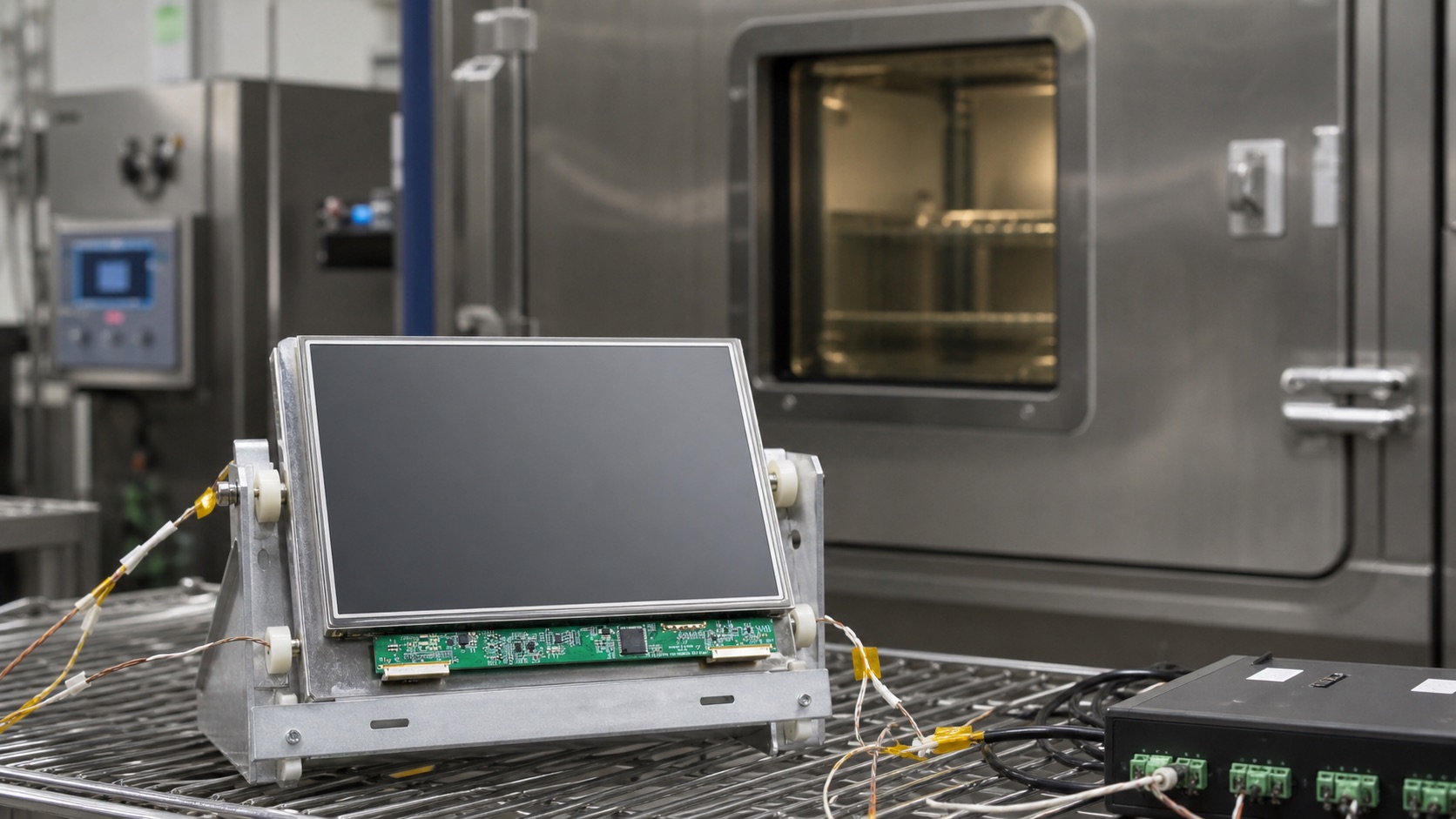
Selecting a display for outdoor terminals, transportation electronics, cold-chain equipment, agricultural machines, and industrial control cabinets is rarely a one-variable decision. This guide focuses on designing display systems that operate reliably across wide temperature ranges from an engineering point of view: optical behavior, electrical integration, mechanical stack-up, validation, supply risk, and field reliability.
A wide-temperature rating on a datasheet does not guarantee the complete display assembly will perform well after cover glass, touch, bonding, enclosure, and backlight driver are added. Products can pass room-temperature testing but show slow response in cold weather, black mura in heat, touch drift, condensation, adhesive bubbles, or premature backlight degradation.
The practical recommendation is simple: Validate the complete display assembly across operating and storage temperatures, including startup and recovery behavior. The detailed work is in proving that decision against the real product environment, not against a marketing image or an isolated datasheet value.
1. Decision Summary
| Design area | Engineering implication | Practical note |
|---|---|---|
| Low temperature | Slower liquid crystal response | Check startup and motion |
| High temperature | Backlight and polarizer stress | Manage thermal path |
| Storage | Adhesive and seal risk | Verify non-operating extremes |
| Touch | Controller drift and glove use | Tune in real stack |
| Condensation | Fogging or corrosion | Control sealing and bonding |
The table should not be used as a replacement for qualification testing. It is a way to focus the first design review. In a real project, the display decision should involve electrical engineering, mechanical engineering, firmware, industrial design, purchasing, quality, and the supplier application team. Each group sees a different failure mode: signal margin, enclosure tolerance, boot timing, touch feel, lifecycle risk, or cosmetic yield.
2. Operating vs Storage Ratings
Operating temperature describes when the display should function. Storage temperature describes survival without operation. Confusing the two creates risk. A product may be stored in a vehicle in summer, powered on in winter, or moved from cold storage into humid air. Each condition stresses different materials. Review the LCD, backlight, touch sensor, adhesive, cover lens, and enclosure as a combined assembly.
3. Low-Temperature Behavior
At low temperature, liquid crystal viscosity increases and response time slows. The display may smear during transitions or take longer to reach normal appearance after startup. Touch panels can also behave differently when users wear gloves or when condensation forms. If the application has safety messages or moving indicators, cold response should be tested with actual UI content rather than a static color pattern only.
4. High-Temperature and Sun Load
High temperature accelerates LED aging, polarizer degradation, adhesive stress, and enclosure material issues. Outdoor displays can exceed ambient temperature because of solar loading and backlight heat. A black front surface may absorb significant energy. Thermal design should include heat spreading, backlight derating, ventilation or conduction paths, and software dimming if the internal temperature becomes too high.
5. Condensation and Material Compatibility
Condensation can reduce readability, trigger touch errors, or create long-term corrosion risk. Optical bonding can reduce internal fogging paths, but the chosen adhesive must tolerate thermal cycling and UV exposure. Gaskets, tapes, and cover glass coatings should be selected for the same environment. A display stack is only as reliable as the weakest material interface.
6. Validation Plan
A credible validation plan should use the final display stack, not an open-frame sample sitting on a desk. Build at least one sample with the intended cover lens, touch sensor, bonding method, cable, connector, backlight driver, enclosure, gasket, and firmware. Then test the conditions that match the product: operating temperature, storage temperature, vibration if relevant, ESD, EMI, repeated power cycling, brightness changes, sleep and resume, and long-duration operation.
For optical decisions, inspect the display under the lighting that customers will actually see. For electrical decisions, test with production cable length and realistic grounding. For mechanical decisions, measure tolerance stack-up and assembly repeatability. For software decisions, confirm boot behavior, error recovery, orientation, dimming, and touch calibration. A display that passes a one-hour bench test can still fail when installed in a sealed enclosure, driven at full brightness, or used by an operator wearing gloves.
7. Procurement and Lifecycle Review
Engineering teams should ask suppliers for more than a quotation. Useful documentation includes the LCD datasheet, module drawing, interface timing, backlight electrical data, optical test method, reliability report, RoHS and REACH status if required, packaging specification, PCN policy, and expected lifecycle. If the product is planned for long-term production, identify whether the panel, driver IC, touch controller, LED, polarizer, and adhesive are stable parts or subject to frequent substitution.
Second sources should be considered early. Even when a perfect drop-in alternate does not exist, knowing the nearest replacement helps the team preserve mechanical space, interface flexibility, and firmware options. A display can become a single point of failure for the whole product if the team treats it as a commodity part.
8. Engineering Checklist
- Run thermal cycling on the complete display stack.
- Test cold startup, warm restart, and recovery after storage.
- Measure backlight temperature at maximum ambient and brightness.
- Validate touch operation with gloves, water, and expected cover thickness.
9. Final Recommendation
For embedded and industrial products, the best display choice is the one that remains readable, electrically stable, manufacturable, and available throughout the product lifecycle. Do not approve a display from a single specification or a clean-room demo photo. Approve it after the optical stack, interface, touch behavior, thermal path, firmware, and supplier controls have been reviewed together.
That approach takes more effort during design, but it reduces late redesigns, field complaints, and supply surprises. It is also the difference between a display that simply turns on and a display subsystem that supports the product reliably for years.
Related Engineering Context
For long-life products exposed to component changes and field service constraints, pair this with IPS display lifecycle planning. Define LCD operating, storage, cold-start, and recovery limits separately rather than copying one temperature range into the product specification. If high backlight power is part of the temperature challenge, review the high-brightness TFT display selection guide.