PCAP Touch Panel Design Guide for Industrial Displays
A practical engineering guide to projected capacitive touch panels for industrial displays, covering cover glass, gloves, water, EMI, controller tuning, bonding, grounding, and validation.
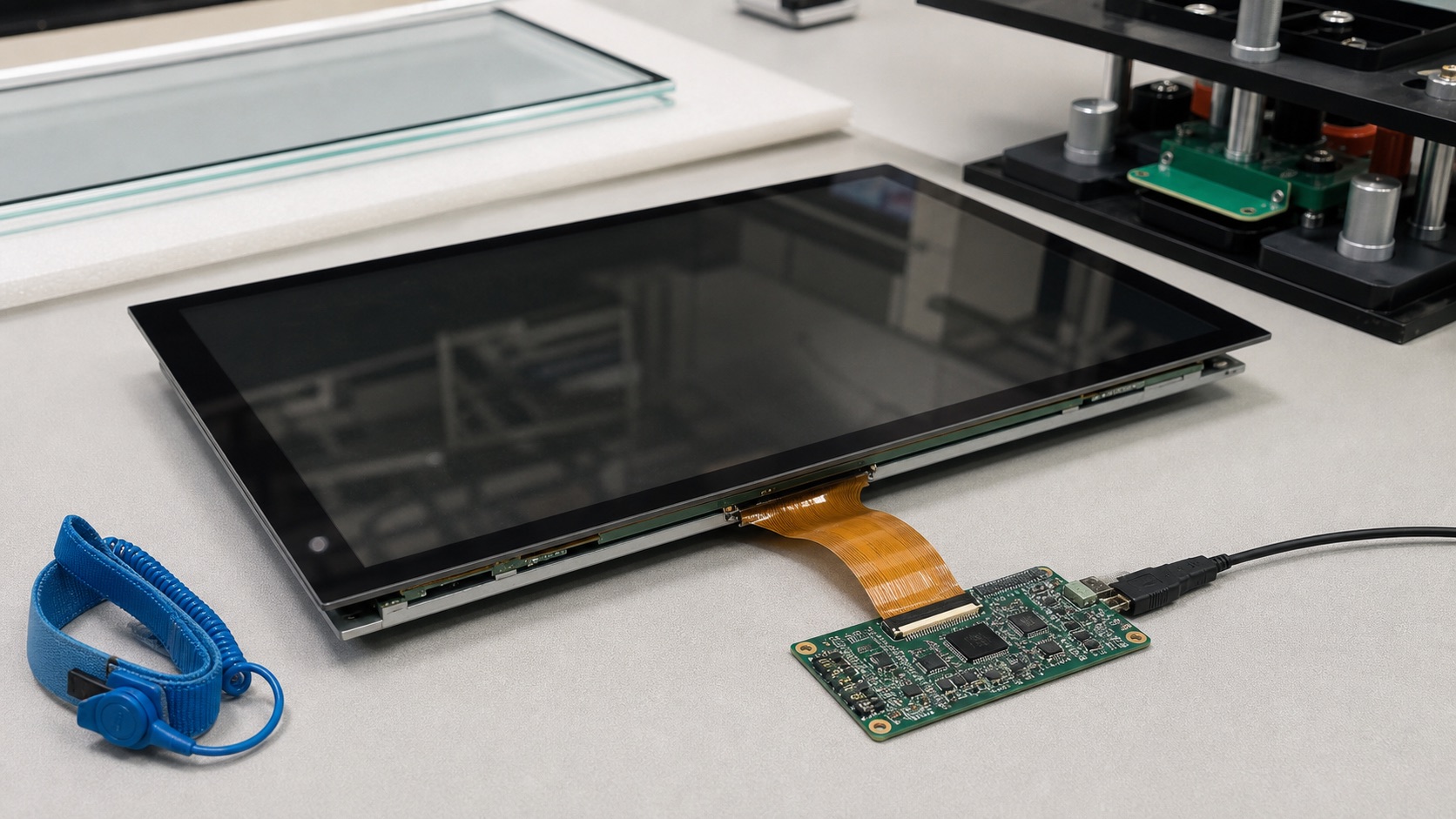
Selecting a display for industrial HMIs, medical carts, outdoor kiosks, EV chargers, smart home panels, and rugged handheld terminals is rarely a one-variable decision. This guide focuses on designing projected capacitive touch systems that remain stable in industrial environments from an engineering point of view: optical behavior, electrical integration, mechanical stack-up, validation, supply risk, and field reliability.
PCAP touch feels modern and durable, but industrial conditions introduce gloves, water, thick cover glass, EMI, grounding differences, and enclosure effects that can make touch unstable. The common issue is approving touch performance on a bare module, then seeing false touches, missed touches, or poor glove response after the final cover lens, bonding, gasket, and grounded enclosure are added.
The practical recommendation is simple: Tune and validate PCAP as part of the complete product stack, not as a standalone touch sensor. The detailed work is in proving that decision against the real product environment, not against a marketing image or an isolated datasheet value.
1. Decision Summary
| Design area | Engineering implication | Practical note |
|---|---|---|
| Cover glass | Improves durability | Reduces signal as thickness increases |
| Gloves | Possible with tuning | Needs defined glove type |
| Water | Manageable | False touch risk |
| EMI | Critical | Grounding and layout matter |
| Bonding | Improves optical stack | Changes touch tuning |
The table should not be used as a replacement for qualification testing. It is a way to focus the first design review. In a real project, the display decision should involve electrical engineering, mechanical engineering, firmware, industrial design, purchasing, quality, and the supplier application team. Each group sees a different failure mode: signal margin, enclosure tolerance, boot timing, touch feel, lifecycle risk, or cosmetic yield.
2. Cover Glass and Sensor Geometry
Cover glass thickness, dielectric constant, ink border, sensor pattern, and air gap all affect touch signal strength. A design that works through 0.7 mm glass may not work through 3 mm chemically strengthened glass without a different sensor or controller tuning. If the product needs vandal resistance or medical cleaning, define the cover lens early and request touch evaluation with that exact stack.
3. Glove, Wet Finger, and Water Behavior
Industrial users may wear nitrile, leather, winter, or coated work gloves. Each glove changes the touch signal differently. Water droplets can look like touches or can create a conductive bridge across the surface. A good PCAP implementation defines supported glove types and water behavior clearly. It is better to specify reliable operation for known use cases than to claim universal glove support without validation.
4. EMI, Grounding, and Enclosure Effects
Touch controllers measure very small capacitance changes, so noisy power supplies, poorly grounded metal enclosures, long FPC cables, and nearby radios can degrade performance. Grounding strategy should be reviewed with the final mechanical design. Shield layers, driven shields, ferrites, and controller filtering may help, but they need testing. Passing touch tests on a plastic bench fixture is not enough for an industrial product.
5. Firmware Tuning and Production Repeatability
PCAP performance depends on controller firmware parameters such as sensitivity, noise filtering, palm rejection, water mode, glove mode, and baseline tracking. These settings should be tied to a specific stack and supplier revision. In production, variation in cover glass, adhesive thickness, sensor alignment, and grounding can shift margin. Keep golden samples and test procedures for incoming inspection and firmware regression.
6. Validation Plan
A credible validation plan should use the final display stack, not an open-frame sample sitting on a desk. Build at least one sample with the intended cover lens, touch sensor, bonding method, cable, connector, backlight driver, enclosure, gasket, and firmware. Then test the conditions that match the product: operating temperature, storage temperature, vibration if relevant, ESD, EMI, repeated power cycling, brightness changes, sleep and resume, and long-duration operation.
For optical decisions, inspect the display under the lighting that customers will actually see. For electrical decisions, test with production cable length and realistic grounding. For mechanical decisions, measure tolerance stack-up and assembly repeatability. For software decisions, confirm boot behavior, error recovery, orientation, dimming, and touch calibration. A display that passes a one-hour bench test can still fail when installed in a sealed enclosure, driven at full brightness, or used by an operator wearing gloves.
7. Procurement and Lifecycle Review
Engineering teams should ask suppliers for more than a quotation. Useful documentation includes the LCD datasheet, module drawing, interface timing, backlight electrical data, optical test method, reliability report, RoHS and REACH status if required, packaging specification, PCN policy, and expected lifecycle. If the product is planned for long-term production, identify whether the panel, driver IC, touch controller, LED, polarizer, and adhesive are stable parts or subject to frequent substitution.
Second sources should be considered early. Even when a perfect drop-in alternate does not exist, knowing the nearest replacement helps the team preserve mechanical space, interface flexibility, and firmware options. A display can become a single point of failure for the whole product if the team treats it as a commodity part.
8. Engineering Checklist
- Test touch with final cover glass, bonding, gasket, and enclosure.
- Define supported gloves, wet conditions, and cleaning chemicals.
- Run EMI and ESD tests while monitoring touch behavior.
- Lock controller firmware and tuning files to the approved hardware revision.
9. Final Recommendation
For embedded and industrial products, the best display choice is the one that remains readable, electrically stable, manufacturable, and available throughout the product lifecycle. Do not approve a display from a single specification or a clean-room demo photo. Approve it after the optical stack, interface, touch behavior, thermal path, firmware, and supplier controls have been reviewed together.
That approach takes more effort during design, but it reduces late redesigns, field complaints, and supply surprises. It is also the difference between a display that simply turns on and a display subsystem that supports the product reliably for years.
Related Engineering Context
For projects still comparing sensor technologies, start with the capacitive vs resistive touch guide to confirm whether PCAP is the right baseline. When the stack is close to approval, use the blog on evaluating touch performance on industrial IPS displays as a practical test checklist.
FAQ
Can PCAP touch work with gloves?
Yes, but glove support depends on glove material, cover glass thickness, sensor design, controller capability, grounding, and firmware tuning. The supported glove type should be defined and tested instead of treated as a generic feature.
Why does water cause PCAP problems?
Water changes the electrical behavior on the touch surface. Droplets can create false touches, block intended touches, or confuse tracking. Outdoor and washdown products should test wet-finger, droplets, wiping, and wet-glove conditions.
How thick can the cover glass be?
There is no universal answer. Thicker glass reduces touch signal and may require a different sensor or controller tuning. The exact stack should be validated with the chosen controller, glass, ink border, adhesive, and enclosure.
What should be controlled after touch approval?
Control the touch controller firmware, tuning file, sensor drawing, cover glass thickness, adhesive thickness, grounding method, and approved sample revision. Small changes can affect field behavior.