Optical Bonding vs Air Bonding: Display Stack Design Trade-Offs
An engineering comparison of optical bonding and air bonding for IPS and TFT displays, covering readability, reflection, impact strength, condensation, rework, cost, and manufacturing risk.
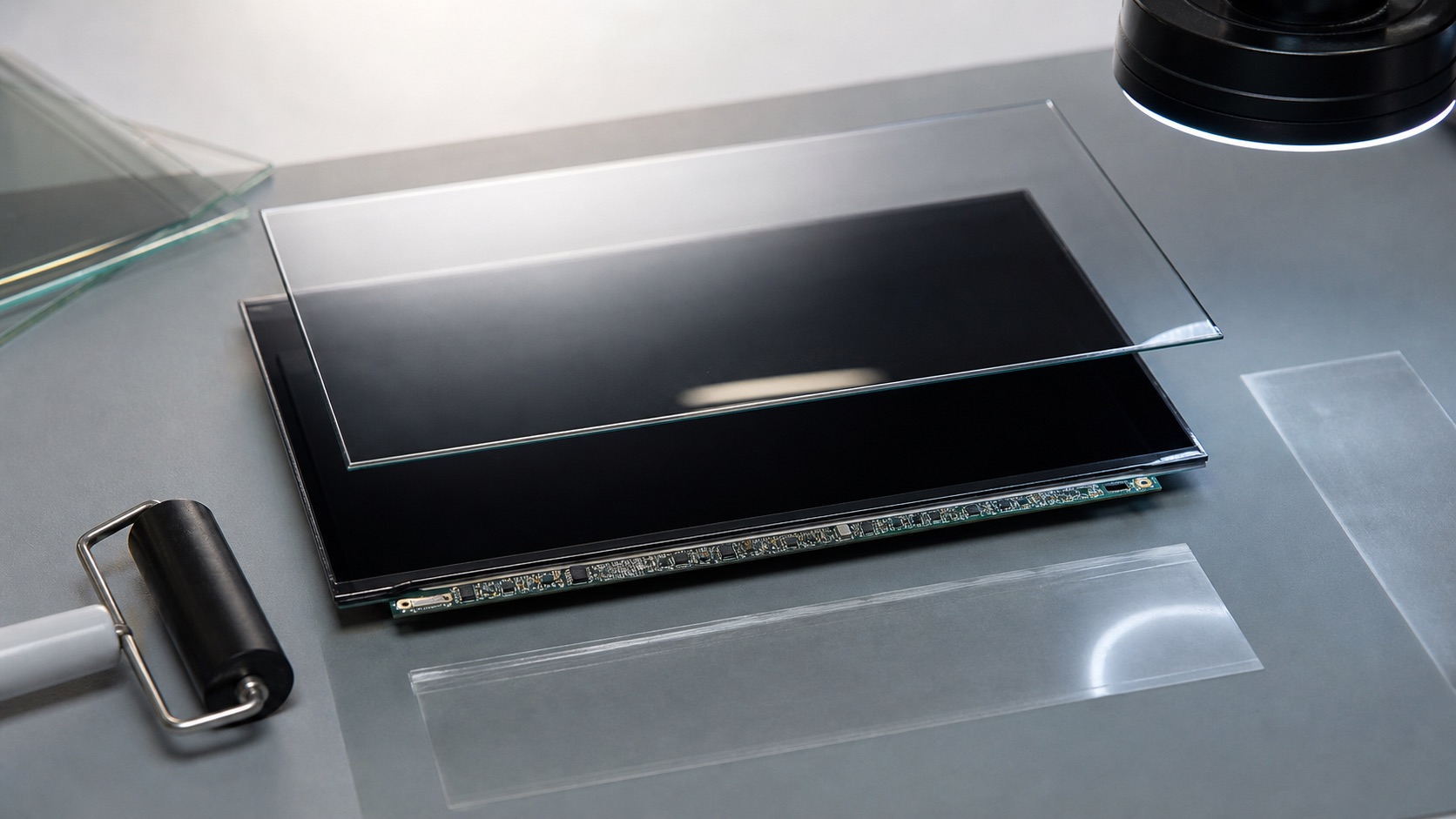
Selecting a display for outdoor HMIs, rugged tablets, medical devices, kiosks, industrial panels, and smart control terminals is rarely a one-variable decision. This guide focuses on deciding whether a display stack should use optical bonding or an air gap from an engineering point of view: optical behavior, electrical integration, mechanical stack-up, validation, supply risk, and field reliability.
Bonding choice affects readability, mechanical strength, condensation behavior, cost, rework strategy, and supplier process capability. A product can look acceptable with an air gap indoors but become reflective outdoors. A poorly controlled bonded stack can create bubbles, mura, adhesive overflow, or difficult rework. Both choices need engineering discipline.
The practical recommendation is simple: Use optical bonding when readability, ruggedness, or condensation control justify the added process cost. The detailed work is in proving that decision against the real product environment, not against a marketing image or an isolated datasheet value.
1. Decision Summary
| Design area | Engineering implication | Practical note |
|---|---|---|
| Readability | Bonding is stronger | Air gap reflects more light |
| Impact strength | Bonding improves support | Air gap is less rigid |
| Condensation | Bonding reduces internal fogging paths | Air gap can trap moisture |
| Cost | Air bonding is lower | Optical bonding adds process cost |
| Rework | Air gap is easier | Bonding needs controlled process |
The table should not be used as a replacement for qualification testing. It is a way to focus the first design review. In a real project, the display decision should involve electrical engineering, mechanical engineering, firmware, industrial design, purchasing, quality, and the supplier application team. Each group sees a different failure mode: signal margin, enclosure tolerance, boot timing, touch feel, lifecycle risk, or cosmetic yield.
2. How the Two Stack Types Differ
Air bonding leaves a physical gap between the LCD, touch sensor, and cover glass. Optical bonding fills that gap with a transparent adhesive such as OCA or OCR. The optical effect is significant because every air-to-glass boundary reflects light. Removing those boundaries improves perceived contrast, especially under high ambient light. The mechanical effect is also important because the layers support each other more evenly.
3. Readability and Reflection
For outdoor displays, optical bonding often produces a bigger real-world improvement than increasing backlight brightness alone. It reduces internal reflections and keeps black areas from washing out. Air bonding can be acceptable for indoor equipment, cost-sensitive products, or applications where the cover lens is not exposed to strong light. The choice should be based on ambient contrast testing, not only appearance in an office.
4. Mechanical Strength and Condensation
A bonded stack can improve impact behavior because the cover lens and LCD are coupled rather than separated by an air cavity. It also reduces surfaces where condensation can form internally. This matters in outdoor, marine, medical, and cold-chain applications. However, bonding introduces adhesive selection and curing requirements. The adhesive must remain clear and stable under temperature cycling, UV exposure, and mechanical stress.
5. Manufacturing and Rework Trade-Offs
Air-bonded assemblies are easier to rework and usually cheaper to produce. Optical bonding requires cleaner process control, alignment, bubble prevention, and inspection. If the LCD panel or touch sensor has high cost, rework strategy becomes important. Engineering teams should discuss acceptable cosmetic criteria, yield expectations, and repair process with the supplier before choosing bonding for volume production.
6. Validation Plan
A credible validation plan should use the final display stack, not an open-frame sample sitting on a desk. Build at least one sample with the intended cover lens, touch sensor, bonding method, cable, connector, backlight driver, enclosure, gasket, and firmware. Then test the conditions that match the product: operating temperature, storage temperature, vibration if relevant, ESD, EMI, repeated power cycling, brightness changes, sleep and resume, and long-duration operation.
For optical decisions, inspect the display under the lighting that customers will actually see. For electrical decisions, test with production cable length and realistic grounding. For mechanical decisions, measure tolerance stack-up and assembly repeatability. For software decisions, confirm boot behavior, error recovery, orientation, dimming, and touch calibration. A display that passes a one-hour bench test can still fail when installed in a sealed enclosure, driven at full brightness, or used by an operator wearing gloves.
7. Procurement and Lifecycle Review
Engineering teams should ask suppliers for more than a quotation. Useful documentation includes the LCD datasheet, module drawing, interface timing, backlight electrical data, optical test method, reliability report, RoHS and REACH status if required, packaging specification, PCN policy, and expected lifecycle. If the product is planned for long-term production, identify whether the panel, driver IC, touch controller, LED, polarizer, and adhesive are stable parts or subject to frequent substitution.
Second sources should be considered early. Even when a perfect drop-in alternate does not exist, knowing the nearest replacement helps the team preserve mechanical space, interface flexibility, and firmware options. A display can become a single point of failure for the whole product if the team treats it as a commodity part.
8. Engineering Checklist
- Compare bonded and air-gap samples under the target lighting condition.
- Review adhesive type, UV stability, temperature range, and cosmetic criteria.
- Define inspection limits for bubbles, dust, mura, and edge overflow.
- Consider rework cost and replacement strategy before production approval.
9. Final Recommendation
For embedded and industrial products, the best display choice is the one that remains readable, electrically stable, manufacturable, and available throughout the product lifecycle. Do not approve a display from a single specification or a clean-room demo photo. Approve it after the optical stack, interface, touch behavior, thermal path, firmware, and supplier controls have been reviewed together.
That approach takes more effort during design, but it reduces late redesigns, field complaints, and supply surprises. It is also the difference between a display that simply turns on and a display subsystem that supports the product reliably for years.
Related Engineering Context
For the broader material and process background, read the optical bonding guide. For outdoor product mistakes that often expose weak optical stacks, see common mistakes when choosing a sunlight-readable TFT display.