Outdoor IPS Display Readability Testing: A Practical Field Method
A field-oriented method for outdoor IPS display readability testing, including lighting conditions, cover glass, bonding, UI contrast, sunglasses, heat, and documentation.
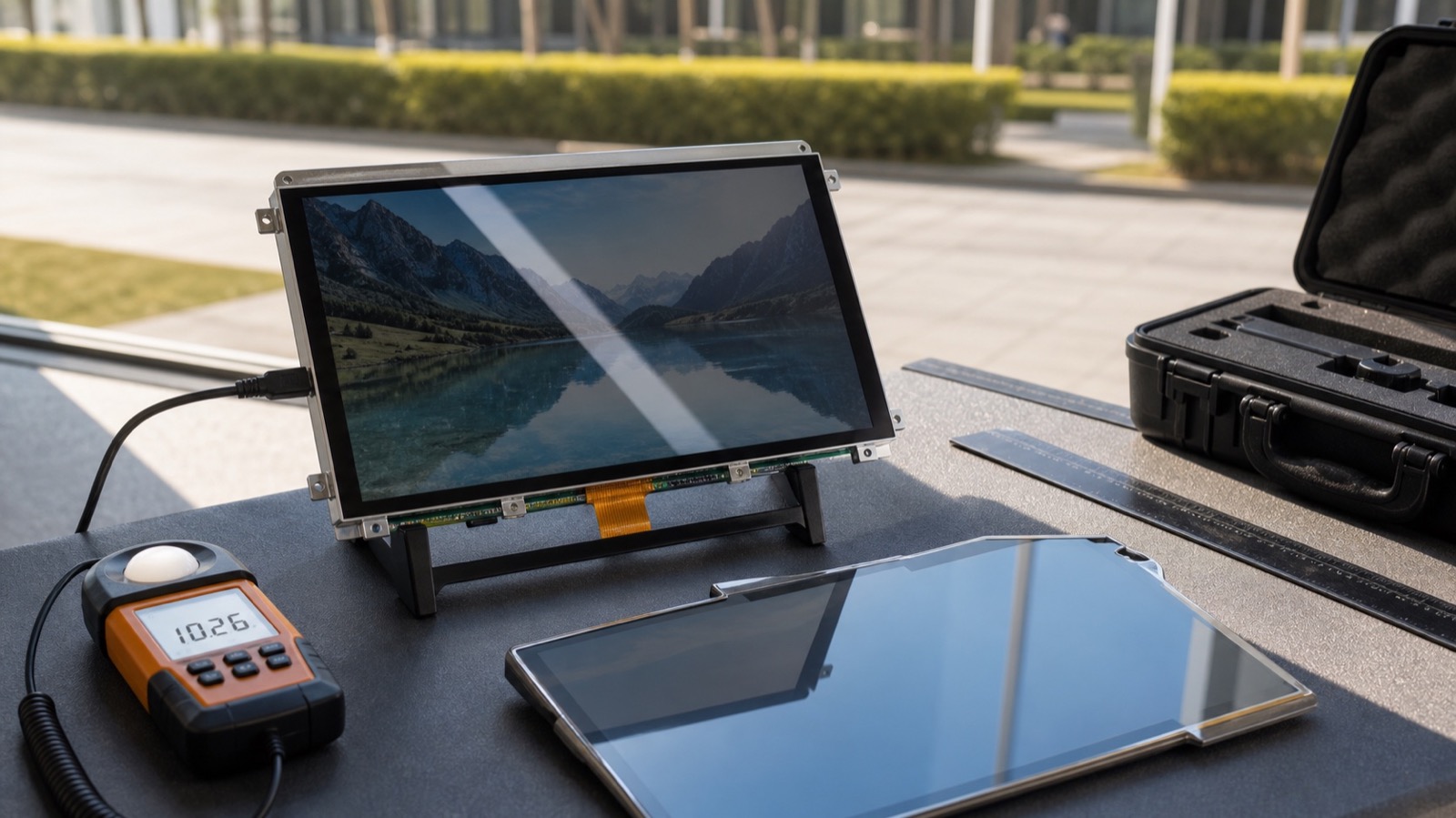
Outdoor readability is easy to discuss and hard to judge consistently. A display can look bright indoors and still be difficult to read outdoors because reflected light reduces contrast. The right test method should evaluate the complete product stack: LCD, backlight, cover glass, touch sensor, air gap or optical bonding, surface treatment, bezel angle, UI design, and heat.
Do not rely only on a nit value. Brightness is important, but the operator sees contrast after reflection, contamination, viewing angle, and ambient light are involved.
Test more than one lighting condition
Outdoor use is not one condition. Test open shade, direct sun, angled sky reflection, bright cloudy weather, and the likely installation angle. A wall-mounted EV charger, vehicle dashboard, marine panel, outdoor kiosk, or 7 inch industrial TFT display for outdoor use can face different light paths. If the product may be mounted in portrait and landscape, test both.
Use the real UI. A white test screen shows brightness, but it does not prove that alarms, small text, gray labels, and touch buttons are readable. Outdoor UIs need stronger contrast and larger critical information than indoor desktop designs.
Practical test checklist
| Check | Why it matters |
|---|---|
| Final cover glass | Reflection changes with surface and thickness |
| Optical bonding | Reduces internal reflection paths |
| Anti-glare / anti-reflective treatment | Controls surface reflection differently |
| Polarized sunglasses | Can change visibility by orientation |
| Fingerprints and dust | Real users do not see a clean lab sample |
| Full brightness heat | Outdoor readability and thermal risk interact |
Measure and observe
Use direct inspection as the main judgment, but record luminance, ambient light, surface temperature, backlight setting, and photos as supporting evidence. Photos are useful for reports, but camera exposure can misrepresent what the eye sees. If possible, include several reviewers and record practical comments: which information is readable, which controls are hard to see, and whether glare creates a safety issue.
For bonded and unbonded stacks, compare them side by side under the same light. A lower-nit bonded display may outperform a brighter air-gap stack if reflections are controlled. This is why outdoor readability should be treated as an optical system, not a backlight contest.
Include contamination and maintenance
Outdoor displays are rarely clean for long. Fingerprints, dust, rain marks, cleaning residue, and scratched cover glass can all reduce contrast. A practical test should include light contamination and a normal cleaning cycle. This is especially important for public terminals, field equipment, marine-adjacent devices, and charging infrastructure.
Surface treatment should be judged after cleaning, not only when new. Some anti-reflective coatings look excellent at first but may be vulnerable to abrasion or aggressive chemicals. Some anti-glare surfaces hide reflections but soften small text. The correct choice depends on the actual maintenance pattern.
Do not ignore heat
Outdoor testing should include temperature. Full backlight plus sun load can heat the front stack and enclosure. Touch behavior, adhesive stability, LED lifetime, and user comfort may all be affected. If the screen is readable only at a brightness level that overheats the product, the design is not complete.
The test report should connect readability and thermal data. Record whether the display was readable at the brightness level that the product can safely sustain. If the display needs maximum backlight all day to remain usable, the team should review bonding, coatings, UI contrast, shading, and dimming strategy before approving the design.
For broader optical trade-offs, read optical bonding vs air bonding. For common selection errors, see common mistakes when choosing a sunlight-readable TFT display.
Outdoor readability testing should be practical, repeatable, and honest. The goal is not to make the display look good in a photo. The goal is to prove users can read and operate it in the field.