Oleophobic and Anti-Fingerprint Coatings for Industrial Cover Glass
Specify and validate oleophobic anti-fingerprint coatings for industrial touch displays using cleanability, contact angle, abrasion, chemical, optical, and touch tests.
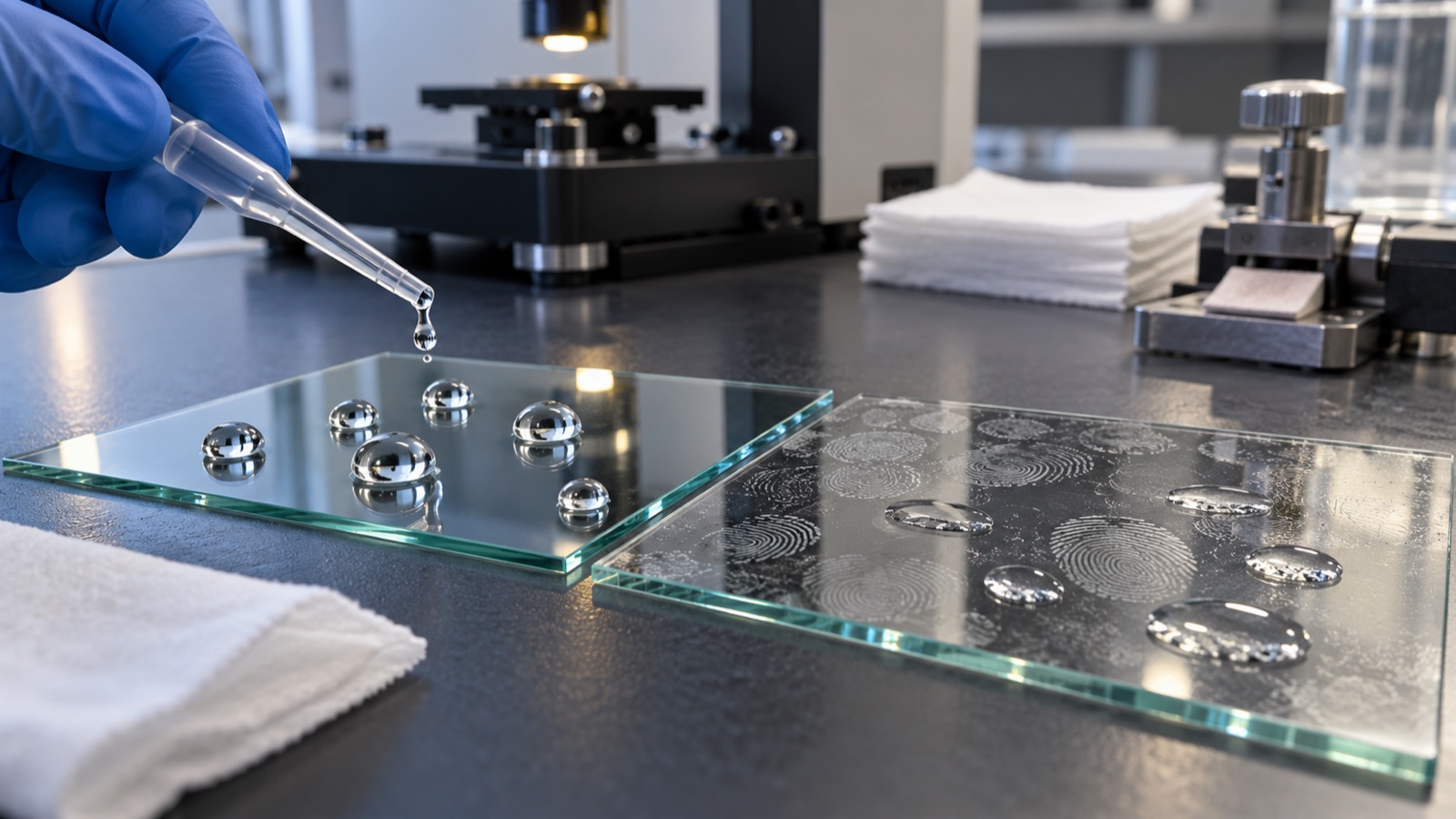
An anti-fingerprint coating does not make fingerprints disappear. It changes the surface energy so skin oils spread and adhere differently, and so residue is generally easier to remove. On an industrial touchscreen, the important question is not how the glass looks on day one. It is how the surface behaves after years of touches, cleaning, disinfectants, gloves, dust, and abrasion.
That makes oleophobic coating a reliability item, not a cosmetic checkbox.
Oleophobic, hydrophobic, and easy-clean are related but different
- Oleophobic describes resistance to wetting by oils.
- Hydrophobic describes resistance to wetting by water.
- Anti-fingerprint describes a user-visible outcome: less obvious residue, easier removal, or both.
- Easy-clean is a performance claim that should be tied to a defined soil and cleaning procedure.
Many surface treatments provide both water- and oil-repellent behavior, but one measurement cannot represent the full experience. A high water contact angle may look impressive while oily fingerprints remain visible under display light.
Why fingerprints become more visible on some optical stacks
Fingerprints are a mixture of oils, salts, moisture, and particles. They alter local refractive index and scatter light. On glossy low-reflection glass, the background reflection is reduced, which can make residue stand out more clearly. Anti-glare texture can diffuse the outline but may hold contamination in microscopic valleys.
Display content, viewing angle, and lighting change visibility. A fingerprint that is nearly invisible on a white screen may be obvious on black content under overhead lighting. Inspect both.
SCHOTT notes this interaction in its anti-reflective anti-fingerprint cover-glass data, where durability is evaluated under repeated rubbing and environmental exposure. Vendor figures are useful screening information, but the assembled product still needs its own cleaning and abrasion test.
Contact angle is a process indicator, not the whole specification
Place a controlled droplet on a clean surface and measure the angle where liquid meets glass. Higher water contact angle generally indicates stronger hydrophobic behavior. Oil contact angles and sliding angles can add information about oily contamination and droplet mobility.
Control the method:
- Liquid type and purity.
- Droplet volume.
- Surface-cleaning procedure.
- Time between deposition and reading.
- Temperature and humidity.
- Location and number of measurements.
- Instrument fitting method.
A freshly coated sample can show a strong initial angle yet lose cleanability after abrasion. Track the value before and after durability tests, and pair it with visual soil-removal scoring.
Start with the actual use environment
An industrial HMI may encounter:
- Bare fingers and nitrile, latex, or work gloves.
- Hand cream, machine oil, cutting fluid, and food grease.
- Isopropyl alcohol, detergent, quaternary disinfectants, or bleach solutions.
- Dry wiping with dust present.
- Public cleaning several times per day.
- Sand, metal particles, and airborne process residue.
List approved and prohibited cleaners in the product documentation. “Chemical resistant” is too vague unless concentration, dwell time, wipe material, cycles, and acceptance criteria are stated.
A practical qualification matrix
Initial characterization
Measure and photograph:
- Water and, if relevant, oil contact angle.
- Sliding or roll-off behavior.
- Haze, transmission, gloss, and color shift.
- Surface friction or a controlled stylus-drag value.
- Fingerprint visibility on black, gray, and white content.
- Wipe count needed to reach an agreed clean state.
The visual test needs a repeatable soil. One approach uses an artificial fingerprint mixture and a controlled stamp force. Another uses trained operators and normalization photographs. Whichever method you select, document it well enough for supplier and incoming inspection use.
Abrasion
Abrasion should represent the cleaning process, not an arbitrary number of rubs. Define cloth material, load, stroke length, speed, and whether contamination is present. Dry dust under a cloth can be much more damaging than a clean microfiber wipe.
Test multiple locations, particularly near bezel edges where coating or cleaning coverage may be less uniform.
Chemical exposure
Apply each cleaner at realistic concentration and dwell time, then perform the specified wipe cycle. Look for:
- Lower contact angle.
- Increased fingerprint retention.
- Streaking or rainbow appearance.
- Damage to anti-reflection layers.
- Haze or color change.
- Edge attack near printing or adhesive.
Environment
High temperature and humidity, UV exposure, thermal cycling, and salt fog may be relevant depending on installation. Evaluate coated glass both as a coupon and in the bonded assembly because edge seals and adhesive outgassing can affect the surface.
Coating durability and scratch resistance are not the same
Oleophobic layers are extremely thin. They can wear while the underlying glass remains unscratched. Conversely, the surface may retain some easy-clean behavior even though the glass has visible scratches.
Specify separately:
- Glass substrate and strengthening.
- Hard coat, if used.
- Anti-glare or anti-reflection treatment.
- Oleophobic top layer.
- Cosmetic scratch criteria.
- Functional easy-clean lifetime.
The industrial display cover-glass specification should treat these as a stack, with compatible processes and acceptance limits.
Coating can affect touch behavior
Projected-capacitive touch senses through the cover stack, so an ultrathin surface treatment normally changes capacitance far less than glass thickness or adhesive. The user interaction can still change:
- Lower friction alters swipe feel.
- Water beads instead of spreading, changing wet-touch behavior.
- Cleaner residue can create conductive films.
- Worn regions can have different friction from untouched regions.
Run PCAP touch testing with gloves, water, and production variation on samples before and after the coating durability sequence. Include edge swipes, multi-touch, drag, and small-target selection.
Optical measurements must follow the complete process
A coating supplier may report excellent transmission on a flat coupon. The final product may combine etched anti-glare glass, black ceramic ink, optical adhesive, touch sensor, and display polarizer. Heat and UV curing can also alter appearance.
Measure:
- Total transmission.
- Haze and clarity.
- Specular reflection.
- Color coordinates on neutral content.
- Sparkle or grain at the intended pixel density.
- Reflection and fingerprint visibility under representative lights.
Use the display haze and image-clarity evaluation to keep wide-angle scatter separate from fine-detail loss.
Incoming inspection that can catch real drift
Contact-angle equipment is valuable, but incoming inspection can combine metrology with simple functional checks:
- Verify coating side and lot traceability.
- Inspect under fixed dark-field and bright-field lighting.
- Measure contact angle at defined sample locations.
- Apply a controlled soil mark.
- Clean with the approved cloth and number of strokes.
- Compare with a retained boundary sample.
Do not touch inspection areas before testing. Packaging films, gloves, and release liners can transfer contamination and distort results.
Writing a useful supplier specification
Include:
| Requirement | Example of a complete definition |
|---|---|
| Substrate | Glass type, thickness, strengthening, edge finish |
| Optical stack | AG/AR treatment, print, bonding compatibility |
| Initial surface | Contact-angle method and minimum result |
| Cleanability | Defined soil, cleaner, cloth, strokes, visual limit |
| Abrasion life | Load, material, cycles, post-test acceptance |
| Chemicals | Concentration, dwell, cycles, pass criteria |
| Cosmetics | Lighting, viewing distance, allowed defect size/count |
| Traceability | Coating lot, glass lot, process date |
Avoid specifying only a trade name. If the source or coating chemistry changes, performance requirements allow an objective requalification.
Design details that extend usable life
- Recess the touch area slightly where the application permits, reducing contact with abrasive objects.
- Keep hard bezel edges from trapping cleaning fluid against coated glass.
- Use approved wipes that lift particles rather than grind them across the surface.
- Avoid printing or adhesive processes that contaminate the viewing area.
- Make cleaning instructions visible to service teams.
- Use replaceable protective films only if their optical and touch effects are validated.
For a bonded industrial interface, the cover surface should be evaluated together with a high-resolution module such as a 10.1-inch 1920 × 1200 IPS display, because pixel density, black level, and touch construction influence how smudges and surface texture are perceived.
Final qualification checklist
- The coating benefit is defined as measurable cleanability, not “fingerprint proof.”
- Contact-angle method and conditioning are documented.
- Abrasion represents the real cloth, load, dust, and cleaning frequency.
- Every approved chemical is tested at use concentration.
- Optical, cosmetic, and touch performance are checked after aging.
- Bonded assemblies and edge areas are included.
- Incoming inspection has retained pass/fail boundary samples.
- Cleaning instructions match the qualification method.
A good oleophobic coating reduces maintenance and keeps a touch display readable, but its value lies in retained performance. Specify the contamination, cleaning process, environment, and acceptable end state. Then test surface energy, optics, touch, and cosmetics together. “Easy to clean after 50,000 representative cycles” is an engineering result; “anti-fingerprint” by itself is only a label.