EV Charger Display Integration: Readability, Touch, and Front-Stack Risks
A practical guide to EV charger display integration, covering outdoor readability, PCAP touch, cover glass, optical bonding, thermal margin, vandal resistance, and lifecycle planning.
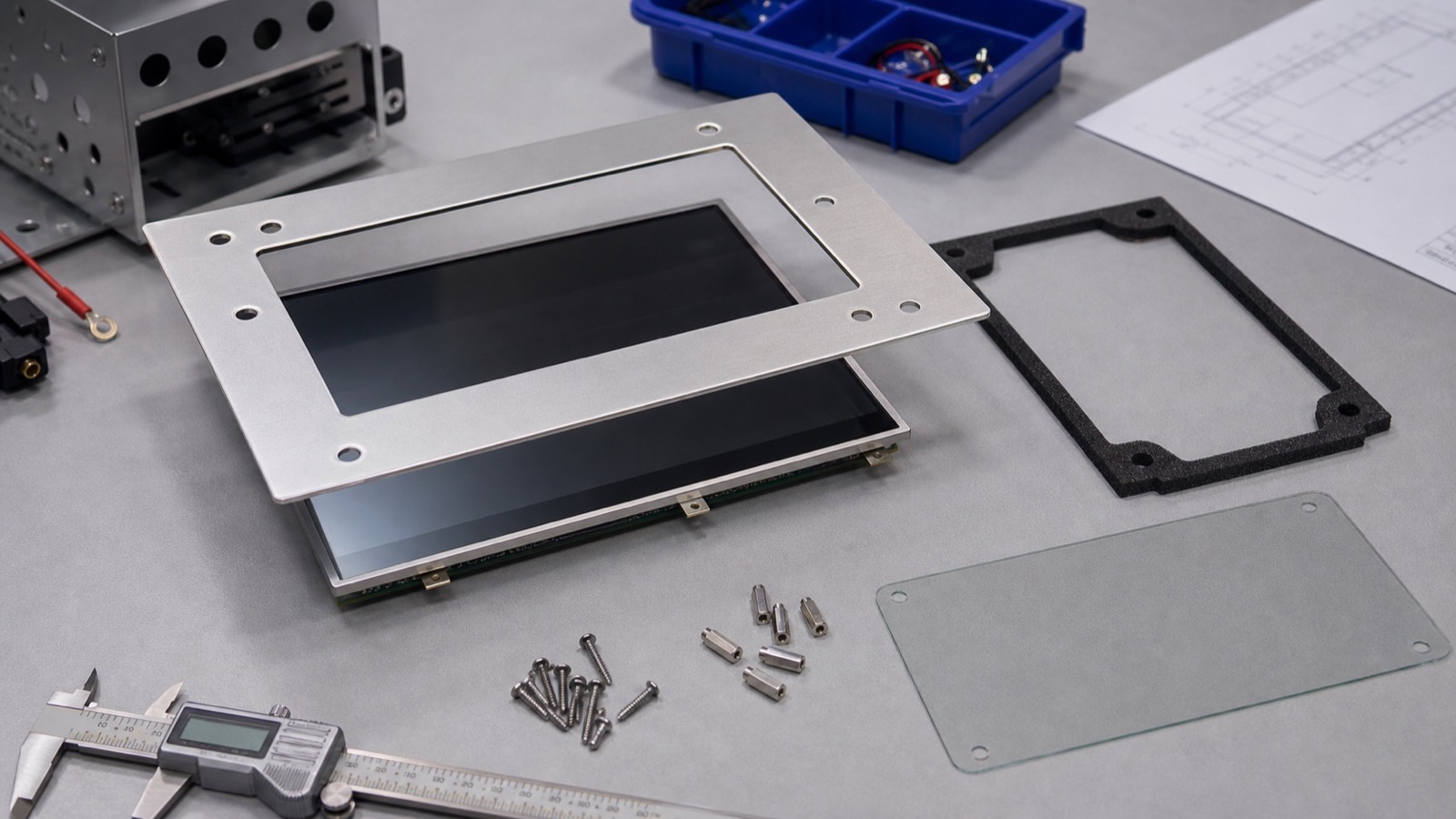
EV charger displays combine several hard requirements in one front stack. The screen must remain readable outdoors, survive public use, support touch interaction, tolerate heat and cold, handle cleaning, and remain available for long-term production. A display that works on a development bench may not be ready for a charger installed in sunlight, rain, dust, and daily user contact.
IPS displays are commonly used because they provide stable viewing angles and broad size availability. Many compact charger interfaces start from a 7 inch industrial TFT display for outdoor use because the size can balance readability, touch area, and enclosure cost. The integration work, however, is what decides whether the display performs well in the field.
Outdoor readability comes first
An EV charger screen is often viewed under open shade, direct sun, reflected sky, or nighttime lighting. High brightness helps, but it is not enough. The cover glass, touch sensor, air gap, optical bonding, anti-glare treatment, anti-reflective coating, and UI contrast all affect readability.
For many charger designs, optical bonding is worth evaluating because it reduces internal reflections and improves front-stack rigidity. The UI should also be designed for outdoor use: large critical values, strong contrast, clear payment or charging states, and minimal reliance on subtle gray text.
Touch and cover glass
Projected capacitive touch should be tested with the final cover glass and enclosure. Public equipment may need thicker strengthened glass, printed borders, sealing, vandal resistance, and wet-finger behavior. Thick glass can reduce touch signal, while water and gloves can create tuning trade-offs.
Do not approve touch from a loose sample. Test with the charger front panel, grounding, gasket, cable route, and power system. If the charger includes cellular, Wi-Fi, power conversion, or long internal cables, EMI review should include touch monitoring.
Integration checklist
| Area | Check before approval |
|---|---|
| Optical | Sunlight readability with final cover stack |
| Touch | Wet finger, glove, edge accuracy, EMI |
| Mechanical | Glass strength, gasket, bezel, cable strain |
| Thermal | Full brightness under sun load |
| Service | Replaceable front assembly or display module |
| Lifecycle | Panel availability and PCN control |
Thermal and lifecycle risk
EV chargers may operate outdoors for years. Full-brightness backlights generate heat, and sun load can push the display stack above ambient. Measure internal temperature and front glass temperature during realistic operation. Derating and automatic dimming can protect lifetime, but the screen must remain readable when a user needs it.
Lifecycle planning is also important. A display change may affect the front glass, touch tuning, firmware, enclosure, and service parts. Identify near alternates early and keep documentation under control.
Service strategy matters
For field equipment, decide whether the service part is the LCD module, the bonded display assembly, or the full front panel. A bonded display may be more rugged and readable, but replacing only the LCD later may not be practical. Service strategy should be defined before production, not after the first field failure.
Also consider vandal resistance and cleaning. Public chargers may need strengthened cover glass, sealed edges, abrasion-resistant coating, and a front design that does not trap water around the bezel. These choices affect touch tuning and optical performance, so they should be reviewed with the display supplier early.
The payment and charging workflow should be tested on the final screen. Users need to see price, connector status, instructions, error messages, and authorization feedback quickly. If glare hides a payment prompt or touch becomes unreliable in rain, the display problem becomes a service and revenue problem, not only a hardware issue.
For outdoor optical decisions, read the outdoor readability and optical bonding guide. For long-term supply planning, review IPS display lifecycle planning.
An EV charger display is not just a screen. It is the public interface to a power system, payment flow, and service experience. Treat it as a complete subsystem from the start.