Display Supplier Documentation: What to Request Before Sourcing
A practical sourcing checklist for IPS display supplier documentation, including datasheets, drawings, PCN policy, reliability reports, timing data, and production control.
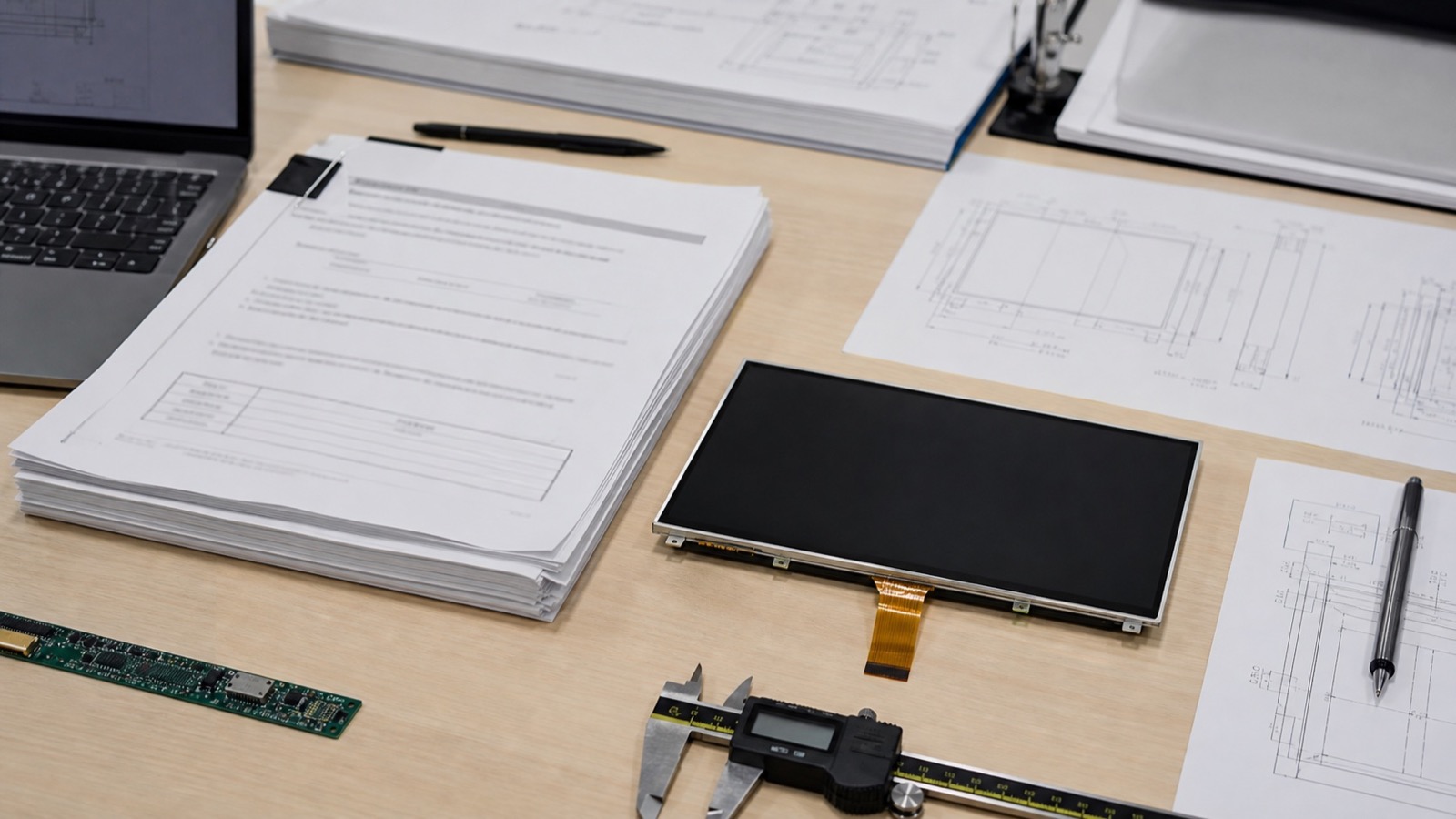
A good IPS display sample is not enough to release a product. For industrial and embedded systems, supplier documentation often decides whether the display can be integrated, qualified, purchased, and maintained over the product life. Weak documentation creates hidden engineering cost. It slows firmware bring-up, causes mechanical uncertainty, weakens incoming inspection, and makes supplier changes harder to evaluate.
The best time to request documentation is before sourcing is locked. Once the enclosure and board are designed around a module, the project has less leverage and fewer alternatives.
Core documents to request
Start with the LCD datasheet, mechanical drawing, interface timing, pin assignment, backlight electrical data, optical specification, operating and storage temperature range, reliability test summary, packing specification, and lifecycle status. If the module includes touch, request the touch controller datasheet, sensor drawing, cover glass drawing, tuning file information, and supported glove or wet behavior.
For custom modules, request a controlled drawing package that includes LCD, FPC, backlight, touch sensor, cover lens, adhesive, and final assembly dimensions. Email descriptions are not enough for production control.
| Document | Why it matters |
|---|---|
| Mechanical drawing | Enclosure, bezel, cable, and fixture design |
| Interface timing | Firmware and display bring-up |
| Backlight data | Power, heat, dimming, lifetime |
| Reliability report | Qualification planning |
| PCN policy | Change control and supply risk |
| Packing spec | Incoming quality and logistics |
| Lifecycle statement | Long-term product planning |
PCN policy is not optional
For long-life products, process change notification is part of the engineering decision. Ask what changes require notification. Driver IC, touch controller, LED bin, polarizer, adhesive, FPC, connector, bonding process, and firmware changes can affect form, fit, function, or reliability.
The supplier should explain how much notice is given, whether samples are provided, and what information is included. If the answer is vague, treat it as a risk. A low-cost module with uncontrolled substitutions can cost more than a better-documented part.
Documentation should match the sample
Check that the datasheet revision, drawing revision, sample label, and quotation refer to the same module. It is common for early samples to use a near-equivalent panel or temporary FPC. That is acceptable during exploration, but it must be clarified before approval.
Keep documents under version control with the product files. Future engineers should be able to identify which display revision was approved and what tests were run. This is especially important if the project uses Linux device tree settings, MIPI initialization commands, PCAP tuning files, or custom cover glass.
Treat missing documents as engineering risk
Not every project needs a perfect documentation package, but missing documents should be visible in the risk review. If there is no reliability report, the team may need more internal testing. If there is no PCN policy, purchasing should understand the supply risk. If the timing data is incomplete, firmware bring-up may take longer. The goal is not to reject every supplier with a gap. The goal is to know which gaps can affect schedule, quality, or future maintenance.
Sourcing checklist
- Request current controlled documents, not only marketing PDFs.
- Match every sample to a document revision.
- Confirm lifecycle status and PCN process.
- Ask which components are controlled and which may vary.
- Keep approved drawings, timing, firmware, and test reports together.
- Define what changes require reapproval before production.
For broader lifecycle planning, read IPS display lifecycle planning for long-term embedded products. For the technical selection process before sourcing, use the industrial LCD display selection guide.
Supplier documentation is not paperwork for its own sake. It is how the display decision stays stable after the first sample looks good.