Backlight Thermal Margin in High-Brightness IPS Displays
An engineering guide to backlight thermal margin in high-brightness IPS displays, covering LED current, enclosure heat, dimming, derating, and lifetime risk.
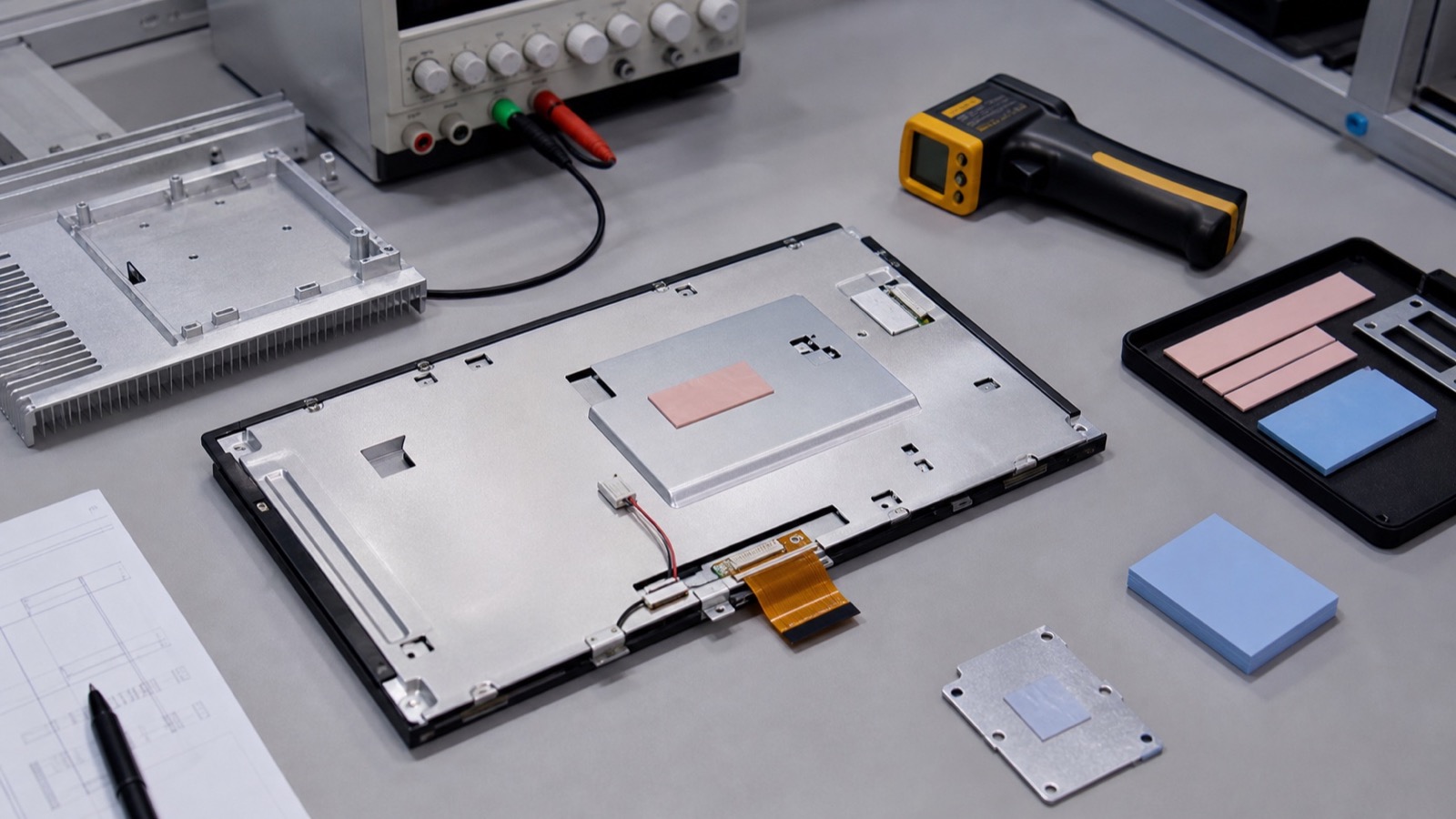
High-brightness IPS displays are usually selected for readability, but the backlight should also be treated as a thermal component. A 1000-nit or 1500-nit display can draw meaningful power. Much of that power becomes heat inside the module and enclosure. If the thermal path is weak, the product may pass an early visual demo and still suffer from reduced LED lifetime, hot surfaces, touch instability, or enclosure reliability problems.
The key mistake is treating brightness as an isolated optical number. Brightness, current, heat, dimming, lifetime, and enclosure design all belong in the same review.
Understand the heat path
Backlight heat starts at the LED string and spreads through the light bar, frame, PCB, metal back plate, adhesive, air gaps, and enclosure. A display module mounted in open air behaves differently from one sealed behind glass in a plastic enclosure. Outdoor products can also receive solar heat through the front surface, pushing internal temperature well above ambient.
The product team should know the backlight current, driver efficiency, connector rating, cable voltage drop, LED derating curve, and expected duty cycle. If the supplier provides lifetime at a specific LED case temperature, compare that condition with your actual enclosure measurement.
What to measure
| Measurement | Reason |
|---|---|
| Backlight current | Confirms electrical stress |
| Driver temperature | Shows power conversion margin |
| LCD back surface temperature | Indicates module heat load |
| Enclosure internal temperature | Reveals trapped heat |
| Front glass temperature | Affects user comfort and touch |
| Luminance after warm-up | Shows brightness drift |
Measure at maximum backlight and expected worst-case ambient. If the product uses automatic dimming, test both maximum output and normal control behavior. A dimming strategy is helpful only if it preserves readability under real lighting.
Design responses
Thermal margin can be improved by derating LED current, using a more efficient backlight driver, adding heat spreading, improving enclosure conduction, allowing airflow, reducing unnecessary full-bright operation, or using optical bonding and reflection control so the display does not need as much emitted light. Sometimes the best way to reduce heat is not a bigger backlight, but a better front stack.
Firmware should also participate. Idle dimming, night mode, ambient light control, and fault handling can protect lifetime. However, safety-related products should define a minimum readable brightness so the display does not dim too far during critical operation.
Review lifetime as a system number
Backlight lifetime is often specified as time to a percentage of initial brightness under defined temperature conditions. That number should not be copied directly into the product plan unless the thermal condition matches the real enclosure. If the LEDs run hotter than the datasheet assumption, the practical lifetime may be shorter.
For long-life equipment, estimate brightness at end of service life, not only on day one. A display that starts at 1000 nits may still need to meet a minimum readability target after years of use. That may justify derating, better heat spreading, or a slightly brighter module operated below maximum current.
Approval checklist
- Test at maximum ambient and maximum backlight.
- Compare measured temperature with LED lifetime assumptions.
- Confirm connector and cable current rating.
- Validate touch behavior while the display is hot.
- Check front glass temperature for user contact.
- Document dimming behavior and thermal derating rules.
The high-brightness TFT display selection guide covers the broader selection process. For outdoor systems, pair this review with common mistakes when choosing a sunlight-readable TFT display and the size-specific notes on a 7 inch industrial TFT display for outdoor use.
Backlight heat is manageable when it is designed early. It becomes expensive when discovered after the enclosure, power system, and front stack are already fixed.